Qualify the load
Pharmaceutical and grocery operations may require condition, lot or release evidence before inventory enters automated flow.
A vertical label is not a design input. We translate the business context into SKU depth, order release, load units, peak factor, temperature, human interaction and recovery cases.
Profiles frame discovery questions; they do not assert capacity before site data and exception logic are tested.
| Vertical | SKU / demand shape | Load-unit mix | Peak / environment | Control emphasis |
|---|---|---|---|---|
| E-commerce | Deep SKU range, small orders, cutoff waves and promotions. | Totes, cartons, mobile racks and pallets. | Short high peaks with dense operator interaction. | Station balance, congestion and backlog clearance. |
| Grocery | Store sequence, freshness windows and replenishment-led demand. | Pallets, roll cages, totes and mixed cases. | Temperature zones and time-bound dispatch. | Zone transitions and sequence integrity. |
| Manufacturing | Consumption linked to takt, work order and component call-off. | Pallets, carts, bins and returnable containers. | Stable cadence; missed delivery has high consequence. | Priority, line-side handshake and fallback. |
| Pharmaceutical | Lot-controlled demand with release and traceability rules. | Sealed totes, cartons and controlled storage units. | Restricted access and documented intervention. | Identity, audit trail and exception authorization. |
| Cold storage | Variable velocity inside temperature-separated zones. | Pallet and tote formats exposed to frost or condensation. | Low temperature affects batteries, sensors and people. | Environmental limits and recovery access. |
Control architecture is examined where identity, timing or physical capacity becomes exposed, rather than applying one technology label to the whole facility.
Pharmaceutical and grocery operations may require condition, lot or release evidence before inventory enters automated flow.
Dense storage can improve cube use, while direct selectivity protects maintenance isolation, SKU flexibility and exception recovery.
Mission and conveyor rate include crossing delays, charging, merge logic, route blocks and the result of a disabled resource.
An operator, robot or workcell needs a defined ready state, physical capacity and timeout response before dispatch.
Fault isolation, manual bypass and backlog clearance determine whether a local exception propagates across fulfillment.
Fixed automation vs flexible robotics: fixed machinery can provide deterministic capacity for stable flow; robot fleets can phase faster and adapt layouts, but traffic, charging and radio conditions add dependencies.
Peak rate vs operational resilience: maximizing output can reduce buffer margin or alternate paths. Redundancy and graceful degradation may lower a headline rate while sustaining usable output during faults.
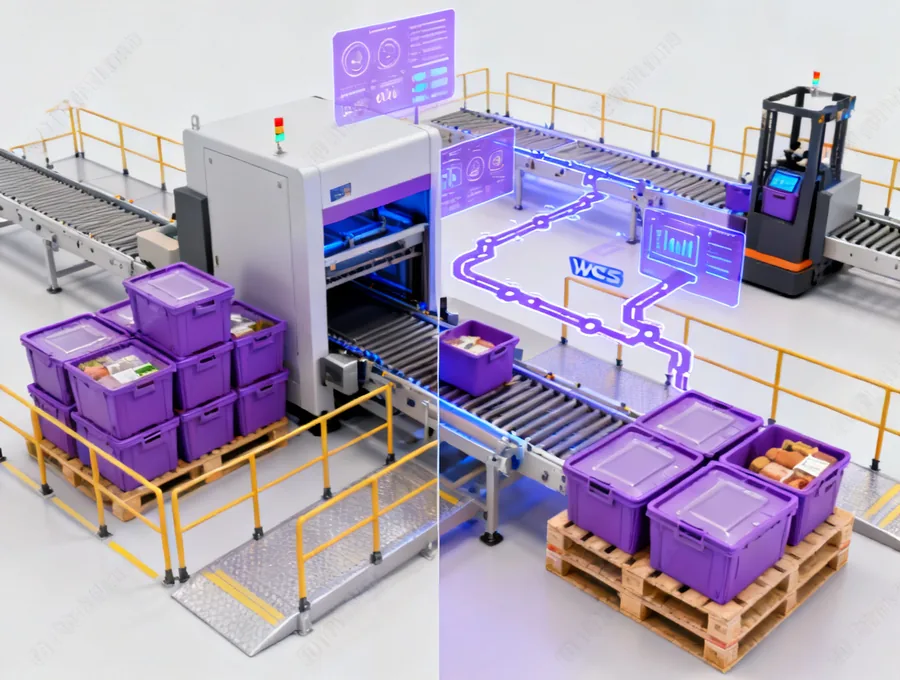
Centralized control vs modular orchestration: a WCS/WES can coordinate global decisions and one operational view; modular controls can isolate failures and limit supplier dependency. Latency, change governance and support competence shape the decision.
Define wait, divert, return and escalation behavior, including which layer owns the next state.
Prevent physical movement from outrunning the WMS or WCS record after a scan or confirmation fails.
State retry limits, duplicate handling, safe local behavior and reconciliation after communication returns.
Measure altered release logic, backlog location, peak-window exposure and time to stable recovery.
Attach order-line or mission distributions, load families, cutoffs, replenishment behavior, interface diagrams and the exceptions operations considers unacceptable.